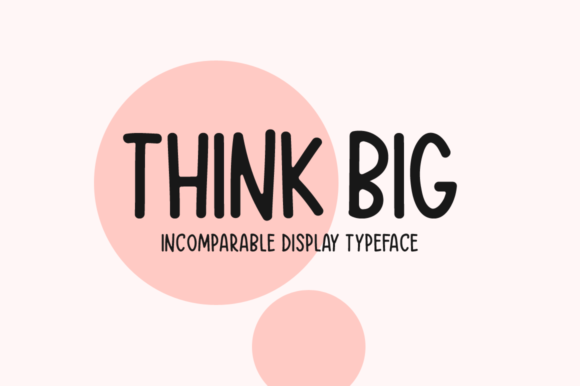
Think Big: The Display Font That Commands Attention
Let’s be honest: most projects live or die by their first impression. You could have the most brilliant product, the most insightful blog post, or the most heartfelt invitation, but if the typography doesn’t grab your audience in that split-second window, you’ve already lost them. That’s where a font like Think Big enters the conversation. It’s not just another display typeface sitting in your font library—it’s a statement piece, the kind of design asset that transforms a flat layout into something people actually stop scrolling to look at.
Think Big is a bold, eye-catching display font built for moments that demand attention. Its letterforms carry a confident, modern energy without veering into the territory of being overly trendy or gimmicky. The weight is substantial, the proportions feel deliberate, and there’s an inherent versatility in its character that makes it work across wildly different contexts. Whether you’re designing a logo for a startup, laying out packaging for a new product line, or creating a social media graphic that needs to pop against a cluttered feed, this typeface delivers visual impact without sacrificing legibility.
A Typeface Built for Real-World Projects
One of the biggest frustrations designers and creatives face is finding a font that looks incredible in a mockup but falls apart in practical application. Think Big sidesteps that problem. Its construction is sturdy enough for large-scale poster printing, yet refined enough to work in digital environments like website headers and email banners. The letter spacing and kerning have been carefully tuned, which means you spend less time manually adjusting and more time actually designing.
Consider the range of projects where a premium font like this genuinely makes a difference:
- Logo design and brand identity: A distinctive display font anchors a visual identity system. Think Big’s personality is strong enough to serve as the primary wordmark for a brand while remaining flexible enough to pair with a clean sans serif or serif font for body copy.
- Packaging design: On a shelf—physical or digital—packaging has roughly three seconds to communicate what a product is and why someone should care. Bold typography is one of the most effective tools for that job.
- Social media graphics: Instagram carousels, Pinterest pins, Facebook ads—these platforms are visually saturated. A creative font with real character helps your content stand out in a feed full of generic templates.
- Editorial layouts and blog design: Pull quotes, section headers, and feature titles benefit enormously from a typeface that carries visual weight without overwhelming the surrounding content.
- Invitations and greeting cards: For crafters and stationery designers, Think Big brings a celebratory, high-energy feel that works beautifully for event invitations, holiday cards, and custom prints.
- Merchandise and print-on-demand: T-shirts, mugs, tote bags, and posters all rely on typography that reads well at various sizes and looks sharp on different materials.
- Marketing assets: From sale banners to webinar graphics to pitch deck title slides, having a go-to display font that conveys confidence and professionalism streamlines your entire content creation workflow.
Matching Typography to Your Creative Goals
Choosing the right font isn’t just about aesthetics—it’s about alignment. The typography you select should reinforce the message, mood, and audience expectations of whatever you’re creating. Think Big leans into a modern, assertive visual style. It communicates energy, ambition, and forward momentum. That makes it an excellent fit for brands and projects that want to feel contemporary, bold, and self-assured.
That said, context matters. A fitness brand launching a new app might use Think Big for its primary headline typeface because the font’s dynamism mirrors the brand’s ethos. A children’s party invitation designer might reach for it because its playful-yet-polished look sets the right tone. A tech startup could pair it with a minimal sans serif for a clean, startup-friendly aesthetic. The font adapts to the story you’re telling, which is exactly what you want from a versatile display typeface.
A practical tip: before committing to any font for a branding or commercial project, test it in context. Drop it into your actual layouts—not just a blank document. See how it interacts with your color palette, your imagery, and your body text. Try it at multiple sizes. Check how it renders on different screens if you’re designing for web. Think Big holds up well across these scenarios, but the habit of testing typography in real conditions will serve you well regardless of which font you’re using.
Font Pairing and Visual Consistency
Very few projects rely on a single typeface. The real skill in typography is knowing how to combine fonts so they complement each other without competing. Think Big, as a display font, naturally takes the lead in any pairing. It’s designed to be the headline, the hero, the element that draws the eye first. Pair it with a neutral, highly readable body font—a simple sans serif like a clean grotesque or a classic serif for a more editorial feel—and you’ve got a typographic hierarchy that looks intentional and professional.
Avoid pairing two display fonts together. The visual noise becomes overwhelming, and neither typeface gets the breathing room it needs to do its job. Instead, let Think Big carry the visual weight at the top of the hierarchy, and use your secondary font to handle paragraphs, captions, and supporting information. This approach improves readability across your designs and creates a sense of visual consistency that strengthens brand recognition over time.
If you’re working on a brand identity system, document your font pairings in a style guide. Specify which font is used for headlines, subheadings, body text, and captions. Include size recommendations and color applications. This kind of consistency is what separates amateur-looking design from professional presentation, and it’s especially important for small businesses and entrepreneurs who are building their visual identity from the ground up.
Licensing, File Formats, and Practical Considerations
Before you download and start using any font commercially, always review the licensing terms. Think Big is designed as a commercial font, which typically means you need the appropriate license for your intended use—whether that’s client work, merchandise sales, or digital products. Many premium fonts offer different license tiers depending on the scale of your project or the number of users on your team, so read the details carefully.
Pay attention to what’s included with your purchase. A well-built font package should come with multiple file formats—OTF and TTF for desktop use, and potentially WOFF or WOFF2 if web fonts are part of the offering. Some display fonts also include alternate characters, ligatures, or stylistic variations that expand your creative options. Take a few minutes to explore the full character set when you install the font. You might discover alternates that perfectly suit a specific project.
Also consider how the font performs at different sizes. Display fonts are optimized for larger text, so they may not read well at very small point sizes. That’s not a flaw—it’s by design. Use Think Big where it shines: headlines, titles, logos, and any context where you need text to be immediately visible and visually compelling. For smaller text, lean on your secondary font choice.
Why the Right Display Font Changes Everything
There’s a reason designers obsess over typography. It’s the backbone of visual communication. A thoughtfully chosen display font like Think Big doesn’t just decorate a design—it gives it structure, personality, and emotional resonance. It tells your audience something about who you are before they’ve read a single word of your copy.
For content creators and marketers, investing in a quality typeface is one of the highest-leverage decisions you can make. It speeds up your workflow because you’re not endlessly searching for the right font. It elevates your output because the typography looks intentional rather than default. And it builds brand equity over time because your audience starts to associate that visual style with your name, your business, or your content.
Whether you’re a seasoned designer building out a client’s brand system, a small business owner creating your own marketing materials, or a crafter designing custom invitations for friends and family, having a reliable, versatile display font in your toolkit is non-negotiable. Think Big earns its place in that toolkit not by being flashy for the sake of it, but by being genuinely useful across the kinds of projects real people actually work on every day. That practical versatility is what separates a good font from a great one.