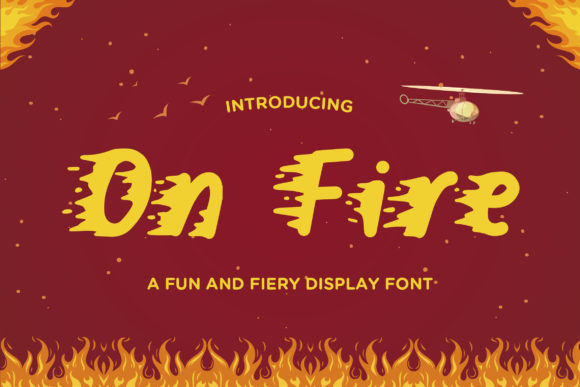
Ignite Your Designs: The Bold Appeal of On Fire
There’s a particular kind of energy you can’t fake in design—it’s the difference between something that just sits on a page and something that leaps off it. If you’ve ever worked on a project that needed a spark of personality, you know the struggle of finding a typeface that feels alive without being chaotic. That’s where a display font like On Fire enters the conversation. It’s not just another stylized typeface; it’s a tool built for moments when your message needs to radiate confidence, warmth, and a touch of playful intensity.
More Than Just a Spicy Aesthetic
On Fire is a display font with a distinct personality. Its letterforms carry a spicy, energetic vibe—think of the kind of typeface that feels like it’s moving even when it’s standing still. The design strikes a balance between originality and approachability, making it versatile enough for both personal craft projects and professional commercial work. It’s the kind of font that can make a social media graphic feel instantly more engaging or give a logo a memorable edge without sacrificing readability.
What makes it visually appealing isn’t just its boldness, but its crafted details. The strokes have a rhythmic quality, with subtle variations that give it a handcrafted feel. This isn’t a cold, geometric typeface—it has warmth. That warmth translates well across different mediums, whether you’re printing it on textured paper or viewing it on a backlit screen. For designers who value character in their typography, On Fire offers a fresh alternative to more conventional display fonts.
Where This Font Truly Shines: Real-World Applications
Let’s talk practical use. A font’s value isn’t in how it looks in a specimen sheet, but in how it performs in real projects. On Fire’s style makes it particularly effective in contexts where you want to grab attention quickly and convey a sense of excitement or creativity.
Consider these scenarios:
- Branding & Logo Design: For businesses in food, entertainment, lifestyle, or creative services, On Fire can become the cornerstone of a brand identity. It works well for logos that need to feel dynamic and approachable. Imagine a boutique hot sauce label, a music festival poster, or a creative agency’s wordmark—the font’s energy aligns naturally with those vibes.
- Packaging & Merchandise: On product packaging, typography needs to communicate quickly and evoke emotion. On Fire’s bold presence makes it ideal for headlines on boxes, bags, or labels. It’s equally effective on merchandise like t-shirts, mugs, or tote bags where the design needs to stand out in a crowd.
- Social Media & Digital Content: In the fast-scrolling world of Instagram, TikTok, or Pinterest, visuals have a split second to make an impact. Using On Fire for quotes, announcements, or video thumbnails can increase engagement because its style feels native to the platform’s energetic culture. It pairs well with clean sans-serif fonts for body text, creating a balanced hierarchy.
- Print & Editorial Design: Don’t limit display fonts to digital use. On Fire can bring life to magazine covers, event posters, or brochure headers. In editorial layouts, it can be used sparingly for pull quotes or section titles to break up monotony and guide the reader’s eye.
- Invitations & Stationery: For weddings, parties, or business events, the font adds a festive, personalized touch. Its handcrafted quality makes it feel special without being overly formal, perfect for invitations that aim to be memorable and fun.
Making It Work for Your Brand
Choosing a font is a strategic decision. It’s not just about what looks cool—it’s about what aligns with your project’s goals and audience. On Fire communicates creativity, energy, and a bit of boldness. It’s best suited for contexts where you want to stand out, not blend in. If your brand identity is playful, modern, and confident, this typeface could be a strong match.
That said, context is everything. A law firm probably wouldn’t use On Fire for its main logo, but a creative consultancy absolutely might. Think about the emotions you want to evoke. Does your audience respond to warmth and spontaneity? Or do they expect sleek minimalism? The font you choose is a silent ambassador for your brand’s personality.
One practical tip: always test a font in your specific use case before committing. Download a trial if available, mock up a headline, see how it looks on your website or in a printed proof. Check the kerning and spacing in your intended size—display fonts often need manual adjustment for perfect results. Also, review what’s included in the font package. Does it come with multiple weights or styles? Are there alternate characters or ligatures? These details can expand your creative options significantly.
Pairing for Impact and Readability
A display font like On Fire rarely works alone. Its strength is in headlines, logos, and short bursts of text. For longer paragraphs, you’ll need a complementary typeface that offers clarity and calm. This is where font pairing becomes essential.
A good pairing strategy is contrast with cohesion. On Fire’s energetic, slightly irregular forms pair well with clean, neutral sans-serif fonts for body text. Think of something like Open Sans, Lato, or Montserrat. The sans-serif provides a visual rest, making the display font pop even more. Alternatively, if you’re going for a more eclectic, layered look, you could pair it with a simple serif font for a touch of classic contrast.
Avoid pairing it with another highly decorative font—that often creates visual noise and hurts readability. The goal is hierarchy: let On Fire grab attention, then let your supporting typeface do the heavy lifting for longer content. Always check how the pairing looks at different sizes and on different devices. What looks great on a desktop poster might need adjustment for a mobile screen.
Considering the Practical Details
If you’re considering using On Fire for commercial work, licensing is a key factor. Most premium fonts come with specific license terms—desktop, web, app, or e-pub licenses—depending on how you plan to use them. Make sure the license covers your intended applications, especially if you’re creating merchandise for sale or embedding the font in digital products. Some licenses are per-user, others are per-project; understanding this upfront avoids legal headaches later.
Also, consider the technical side. Does the font include the character set you need? If you work with multiple languages, check for extended Latin or other glyph support. For web use, you’ll want a webfont format like WOFF or WOFF2, optimized for fast loading. A good font package will include clear documentation and support, which is invaluable when you’re working under a deadline.
Ultimately, a font like On Fire is a design asset—a tool in your creative toolkit. Its value lies in how you use it to communicate, connect, and create something that resonates. Whether you’re designing a brand identity from scratch or refreshing an existing one, having a typeface with this much personality can open up new creative directions. It’s about finding the right voice for your message, and sometimes, that voice needs a little fire.